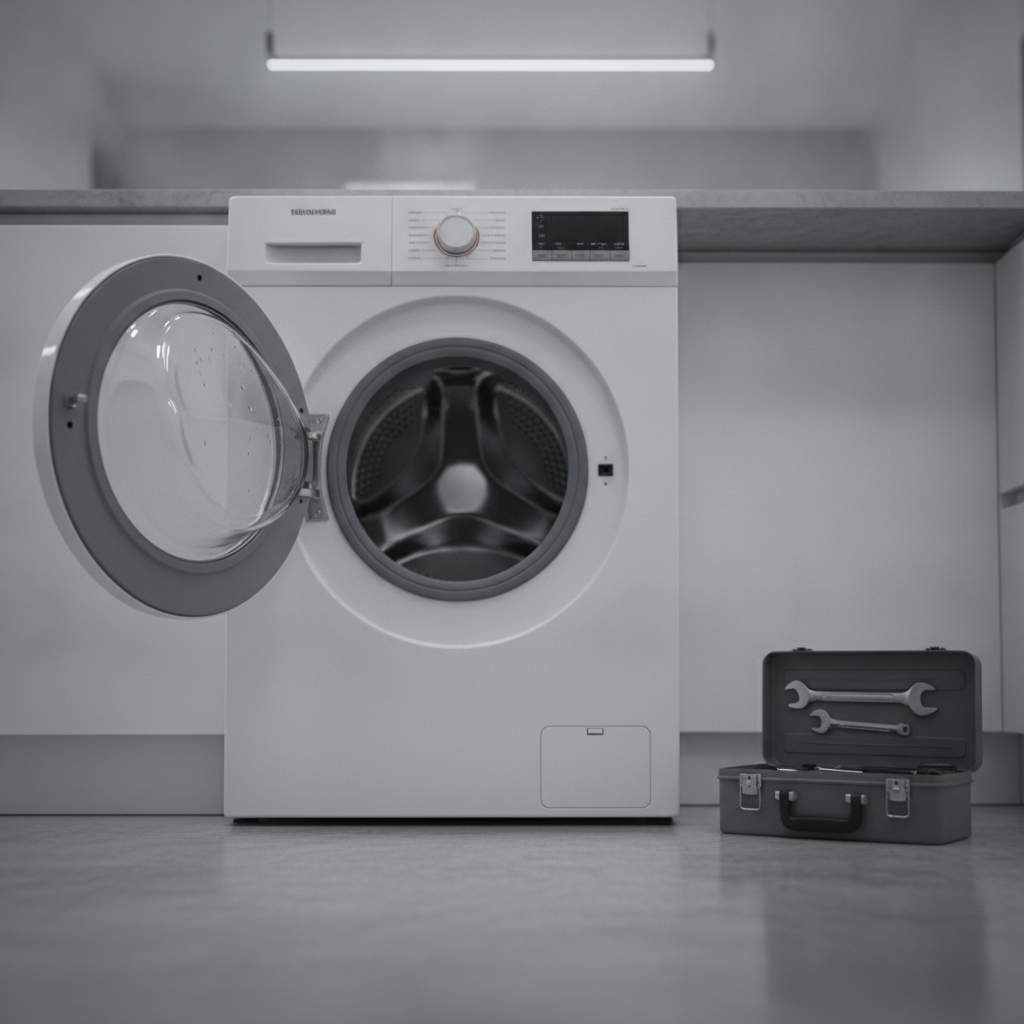
When a washing machine stops mid-cycle, the decision that follows is usually made badly, because it is made under pressure with a wet floor and no information. A few minutes of thought beforehand produces a much better answer than a rushed call to whoever appears first in a search.
The rough rule, and its limits
The common guidance is to replace rather than repair when the repair costs more than about half the price of a new equivalent. It is a reasonable starting point and it misses two things.
The first is age relative to expected life. A repair costing forty per cent of replacement is good value on a three-year-old machine and poor value on a twelve-year-old one, because the next fault is close behind. The second is what else is likely to fail. A machine that has already had two significant repairs is telling you something.
Faults usually worth repairing
Some failures are cheap, well understood and unrelated to the general condition of the appliance.
- Door seals and hinges on washing machines and fridges
- Blocked pumps and filters, which are often not a fault at all
- Thermostats and temperature sensors
- Belts on tumble dryers
- Heating elements, provided the rest of the machine is sound
These are routine parts with predictable costs, and fixing them does not usually signal a machine at the end of its life.
Faults that usually mean replacement
Bearing failure on a washing machine is the classic example. On many modern machines the drum is sealed, so the repair means replacing a large assembly, and the cost approaches the price of a new machine. A compressor failure in a fridge or freezer is the equivalent. Control board failures sit in between: sometimes cheap, sometimes not available at all on an older model.
Parts availability is the quiet decider. Manufacturers support models for a limited period, and once parts are unavailable the decision is made for you.
Get a diagnosis before deciding
Most engineers charge a call-out fee that covers diagnosis, and many deduct it from the repair cost if you proceed. That fee buys you a real answer instead of a guess, which is money well spent before committing to a new appliance.
Ask the engineer two questions beyond the quote: what else on this machine is likely to fail soon, and would you repair it if it were yours. Experienced engineers answer both honestly, because they would rather not come back to the same machine.
Check the warranty and your rights first
Before paying for anything, check whether the appliance is still under manufacturer warranty, whether the retailer offered an extended one, and whether it was bought on a credit agreement that carries protection. Consumer rights on goods that fail earlier than reasonably expected are stronger than most people assume, particularly on expensive appliances that fail within a few years.
It costs one phone call to find out, and it occasionally makes the whole repair-or-replace question irrelevant.